Walking Directions: The next three stops/QR codes cover South Franklin between Ash and the intersection at Grand/Congress St so just stroll the street as you read/listen to the next stops.
Introduction to Stop 9
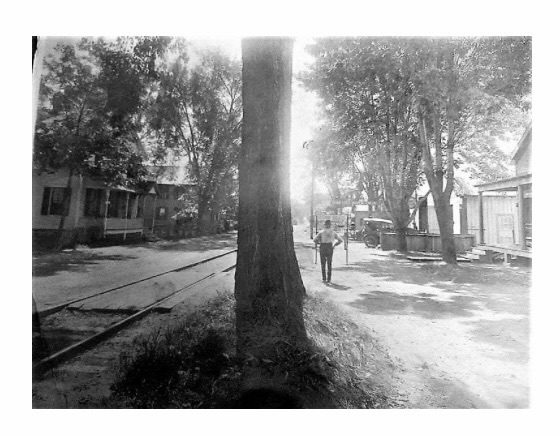
The Story
“For the children, living so near the railroad tracks was an adventure. There was always something to see – the arrival of the race horses, watching them being walked to the track by the local boys, observing the people inside the dining car and waving to the conductors.” (Dublin Revisited)
Mary Ann Cardillo Fitzgerald’s grandparents lived at 27 South Franklin Street with their six children in the 1940s. Mary Ann shares this memory:
“When you sat on the front porch you could see the railroad tracks. The area around the railroad was wide open – not closed in as a normal neighborhood. . . From Aunt Angie LaBelle’s room upstairs, I remember seeing the train coming in, seeing the dining cars, seeing people in the train. I saw the train slowing down as it approached the Railroad Station (presently Price Chopper) waving to people on the train, the engineers.”
Living so close to the tracks also had the added benefit of being able to pick up stray pieces of coal which was very expensive at the turn of the century and well into the Depression era. The houses were kept warm solely by the stoves in the house. Children would pick up stray pieces of coal found along the tracks and take them home to their parents to help with the home heating.
Listen
In the clip below, long time west side resident Jennie Lambert talks about the time in the 1920s when coal was scarce and the working residents of the west side were freezing. A local doctor went to the train station and commandeered a coal car and distributed the contents to his poor neighbors. Jennie recounts another incident where a coal car from the freight train turned over right in front of her house on Franklin street and everyone from the neighborhood ran to pick up the coal for their homes. She was the first house to have a gas stove installed in her home. This interview was recorded in 1974 when Jennie was 88 years old as part of the West Side Oral Narrative Project.
Artwork
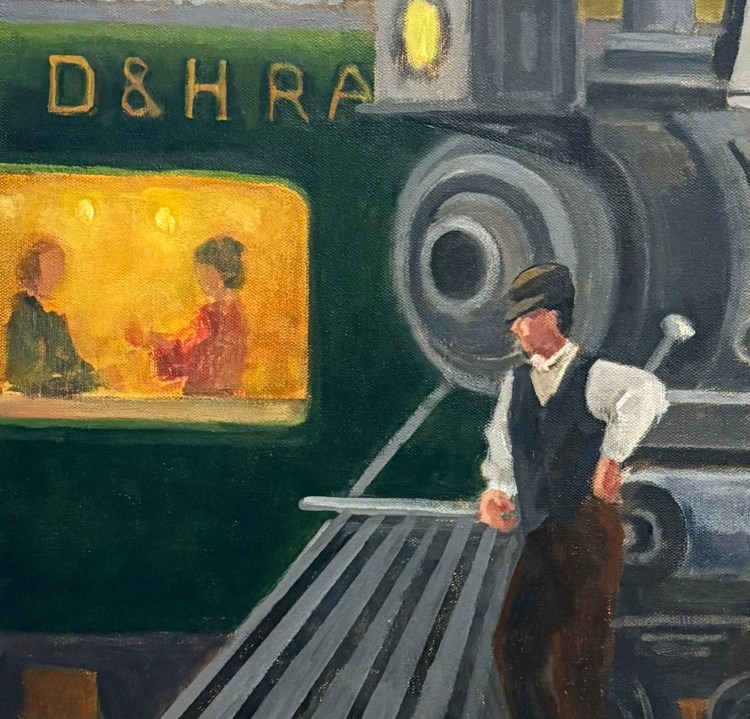
This is a detail of the larger Irish narrative painting. It illustrates Mary Ann’s Fitzgerald’s story of seeing into the dining cars of the arriving trains into Saratoga. The railroad worker was taken from an actual photograph of the Saratoga rail workers in 1832.
 West Side Heritage Tour